LimeSurvey 7.0.5 - Improper authorization in survey menu entry creation endpoint
5.1
Medium
Discovered by

Offensive Team, Fluid Attacks
Summary
Full name
LimeSurvey 7.0.5 - Improper authorization in survey menu entry creation endpoint
Code name
State
Public
Release date
Affected product
LimeSurvey
Vendor
LimeSurvey
Affected version(s)
7.0.5
Fixed version(s)
7.0.12
Vulnerability name
Improper authorization control for web services
Vulnerability type
Remotely exploitable
Yes
CVSS v4.0 vector string
CVSS:4.0/AV:N/AC:L/AT:N/PR:H/UI:N/VC:N/VI:L/VA:N/SC:N/SI:N/SA:N
CVSS v4.0 base score
5.1
Exploit available
Yes
CVE ID(s)
Description
LimeSurvey Community Edition 7.0.5 contains an authenticated improper authorization vulnerability in the survey menu entry creation endpoint.
An authenticated user with only the global settings:read permission can directly invoke POST /index.php/admin/menuentries/sa/create and create new survey menu entries without the expected settings:update privilege. The endpoint also allows the attacker to submit menu IDs that the normal interface and intended update workflow restrict for non-superadministrators, enabling unauthorized changes to administrative navigation records.
The endpoint may return an HTTP 500 response after the request, but the database write has already occurred. The resulting attacker-controlled menu entry can later be observed by a superadministrator in the menu-entry list.
Vulnerability
Root cause
The controller constructor sets the only shared authorization gate for the controller to
settings:read:The legacy
create()action performs no additional authorization check:The intended creation and edit form submits to the stricter
updatehandler:The
update()handler enforces the missing authorization boundary:The same handler attempts to protect main administrative menu entries from non-superadministrators:
The global permission model defines
settings:createas disabled, leavingsettings:updateas the intended modification permission for this area:SurveymenuEntries::save()drops the return value fromparent::save():Because no boolean is returned, the caller sees a falsey value even after a successful insert.
create()then falls through to$this->render('create', ...), which can produce the observed HTTP 500, but this happens after the committed database operation.
Source-to-sink path
Source: an authenticated low-privileged user controls
SurveymenuEntries[...]parameters in a POST request.Controller gate:
SurveymenuEntryController::__construct()accepts the request because the user hassettings:read.Vulnerable action:
create()accepts$_POST['SurveymenuEntries']directly.Missing check:
create()does not enforcesettings:update,superadmin, or the main-menu restriction used in the intended workflow.Persistence:
SurveymenuEntries::save()inserts the new row in{{surveymenu_entries}}.Post-write error: the missing return value causes the action to continue into an invalid render path, returning HTTP 500 without rolling back the insert.
Impact sink: the attacker-created menu entry is stored in the administrative menu-entry configuration and can be verified by a superadministrator.
Impact
An authenticated user with only read access to global settings can perform an unauthorized administrative configuration change by creating survey menu entries. This violates LimeSurvey's permission model, where read-only settings access should not allow modification of global settings or menu configuration.
Potential impact includes:
Unauthorized modification of administrative navigation records.
Creation of misleading or disruptive menu entries in a trusted administrative interface.
Placement of attacker-controlled links or labels that may facilitate phishing or operator workflow disruption.
Increased impact when chained with a separate stored XSS or trusted-link abuse primitive.
The attacker must already have an authenticated LimeSurvey account with settings:read, so this is a privileged but non-superadministrator authorization bypass.
PoC
Preconditions
LimeSurvey Community Edition
7.0.5+260623.A low-privileged authenticated user with global
settings:read.The same user must not have global
settings:update.The same user must not have
superadmin.A valid session cookie and CSRF token for that user.
A superadministrator account to verify menu entries assigned to main administrative menu IDs.
Reproduction
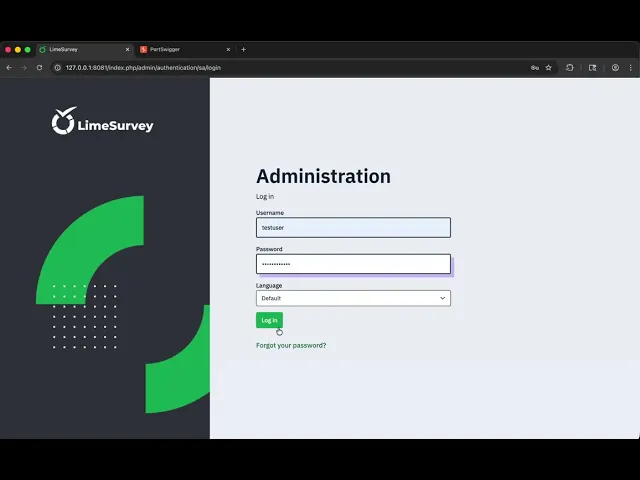
Log in as a user that has only the global
settings:readpermission.Navigate to:
Fill in the form with valid values and intercept the request.
The normal frontend sends new entries to the intended update route:
Change the request path to the legacy creation endpoint:
Set
SurveymenuEntries[menu_id]to a target menu ID, including a main administrative menu ID such as1or2.Send the modified authenticated POST request:
Observe that the server may return:
Log in as a superadministrator and navigate to:
Verify that the unauthorized menu entry is present despite being created by a user with only
settings:read.
Expected result:
The application should reject the request before persistence because the user lacks
settings:updateandsuperadmin.
Observed vulnerable result:
The menu entry is persisted.
The HTTP 500 occurs after the database write and does not prevent the unauthorized change.
Evidence of Exploitation
Video of exploitation:
Static evidence:

Our security policy
We have reserved the ID CVE-2026-65931 to refer to this issue from now on.
System Information
LimeSurvey
Version: 7.0.5
Operating System: Any
References
GitHub Repository: https://github.com/LimeSurvey/LimeSurvey/
Patch: https://github.com/LimeSurvey/LimeSurvey/commit/b043e8268542630dd5bb13c3cb1f8e1baf7f25a2
Mitigation
An updated version of LimeSurvey is available on the vendor page.
Credits
The vulnerability was discovered by Miguel Gomez from Fluid Attacks' Offensive Team.
Timeline
Vulnerability discovered
Vendor contacted
Vendor replied
Vendor confirmed
Vulnerability patched
Public disclosure
Does your application use this vulnerable software?
During our free trial, our tools assess your application, identify vulnerabilities, and provide recommendations for their remediation.