Root Browser Classic 3.3.0 - OS command injection through crafted SQLite filenames
8.5
High
Discovered by

Offensive Team, Fluid Attacks
Summary
Full name
Root Browser Classic 3.3.0 - OS command injection through crafted SQLite filenames
Code name
State
Public
Release date
Affected product
Root Browser Classic
Vendor
Maple Media
Affected version(s)
3.3.0(27917)
Vulnerability name
OS Command Injection
Vulnerability type
Remotely exploitable
Yes
CVSS v4.0 vector string
CVSS:4.0/AV:L/AC:L/AT:N/PR:N/UI:P/VC:H/VI:H/VA:H/SC:N/SI:N/SA:N
CVSS v4.0 base score
8.5
Exploit available
Yes
CVE ID(s)
Description
Root Browser Classic passes the path of a selected SQLite database to an operating-system shell without safely separating the filename from the command. A local attacker can place or induce the victim to save a database file whose filename contains shell syntax, such as command substitution ($(...)). When the victim browses to the file and taps it, the application's SQLite explorer interpolates the attacker-controlled path inside double quotes and executes the resulting string with sh or su.
Double quotes preserve shell command substitution. Consequently, a filename such as poc$(log -t RB_POC COMMAND_EXECUTED).db causes the nested log command to run before sqlite3 attempts to open the database. The file does not need to contain a valid SQLite database.
Vulnerability
Root cause
The root cause is unsafe construction of an operating-system command in SqliteHelper#getTables(). The application concatenates the attacker-controlled database path into a single command string and sends that string to a shell interpreter:
The path is not passed as a separate process argument and is not safely escaped for the shell. Surrounding it with double quotes does not neutralize shell metacharacters because POSIX-compatible shells still perform command substitution, including $(...) and backticks, inside double-quoted strings. Therefore, shell syntax embedded in a database filename is evaluated before sqlite3 receives the resulting path.
Source-to-sink path
Attacker-controlled filename: Root Browser Classic categorizes files ending in
.db,.sql, or.sqliteas databases. The filename may contain characters with shell meaning, including$,(, and).Relevant code in
com.jrummy.file.manager.util.FileType:Reachable browsing location:
RootBrowserActivityis exported and accepts the actioncom.jrummy.root.browser.action.BROWSE_TO. Itsbrowse_to_pathextra becomes the initial directory shown by the file browser. This intent is convenient for reproduction, but exploitation does not depend on another application invoking it; the victim can navigate to the directory manually.Relevant manifest and application code:
Database dispatch after user interaction: When the victim taps a file categorized as
DATABASE,FileListpasses its full path toTableListActivitywithout validation or shell escaping. SQLite exploration is enabled by default through thefb_explore_database_filespreference.Path propagation:
TableListActivityreconstructs aFiledirectly from the intent value.TableListcreatesSqliteHelperand callsgetTables()while loading the database view.Shell selection:
SqliteHelperchoosesshfor any readable file andsuonly for an unreadable file.Command-injection sink:
getTables()concatenates the complete attacker-controlled path into a command string and passes the string to a shell. The double quotes prevent word splitting but intentionally still permit$(...), backtick substitution, and some other shell expansions.
Impact
Successful exploitation provides arbitrary command execution with the Root Browser Classic application UID.
The injected command can read or modify the application's private files and any shared-storage content accessible to the application.
The application has network access, so an injected command can potentially exfiltrate accessible information.
If the user granted
MANAGE_EXTERNAL_STORAGE, the confidentiality, integrity, and availability impact can extend to a broad set of files in shared storage.
PoC
Preconditions
Root Browser Classic 3.3.0 (27917) or 3.4.0 (27919) is installed.
SQLite file exploration is enabled; this preference is enabled by default.
The attacker causes a crafted
.db,.sql, or.sqlitefilename to exist in a location the victim can browse. This can occur through a downloaded or transferred file, or through another local application with access to mutually accessible storage.
Step-by-step
Root access is not needed for this proof of concept. The commands below create a harmless marker in Android's system log.
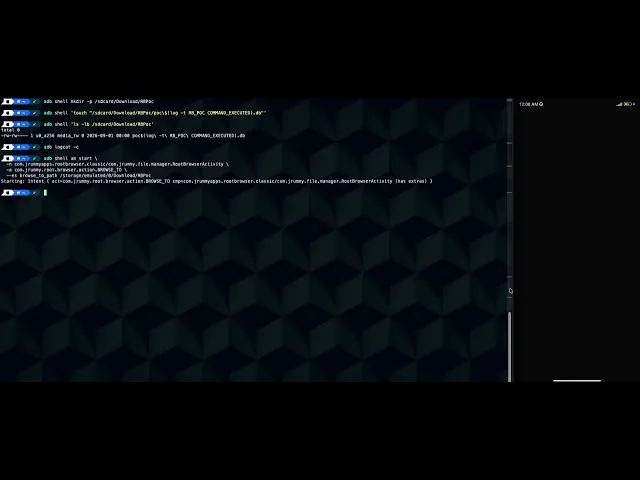
Create a directory and a zero-length file whose literal filename contains a shell command substitution:
Confirm that the listed name contains the literal characters
$(log -t RB_POC COMMAND_EXECUTED).Clear the log and open Root Browser Classic in the proof-of-concept directory:
In Root Browser Classic, tap
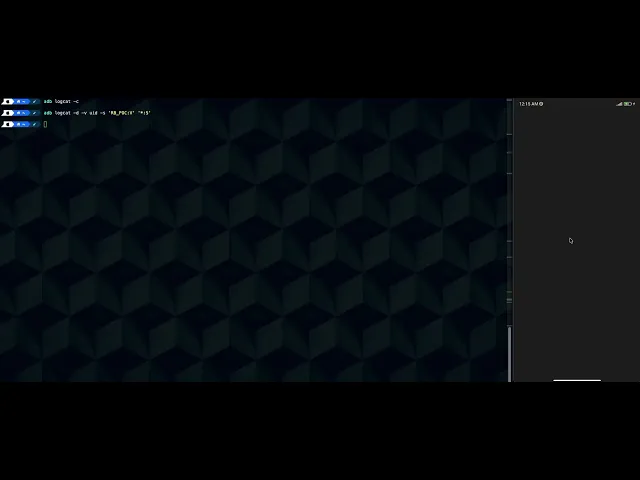
poc$(log -t RB_POC COMMAND_EXECUTED).db. The application may displayFailed loading the database; this is expected because the file is not a valid database and does not prevent the nested command from executing.Query only the harmless proof-of-concept log tag:
Expected result:
Remove the test file:
Evidence of Exploitation
Video of exploitation:
Static evidence:

Our security policy
We have reserved the ID CVE-2026-85082 to refer to this issue from now on.
System Information
Root Browser Classic
Version: 3.3.0 (27917)
Operating System: Android 5.0 and later
References
Google Play listing: https://play.google.com/store/apps/details?id=com.jrummyapps.rootbrowser.classic
Vendor privacy policy: https://maplemedia.io/privacy/
Vendor website: https://maplemedia.io/
Mitigation
There is currently no patch available for this vulnerability.
Credits
The vulnerability was discovered by Andrés Ramos from Fluid Attacks' Offensive Team.
Timeline
Vulnerability discovered
Vendor contacted
Public disclosure
Does your application use this vulnerable software?
During our free trial, our tools assess your application, identify vulnerabilities, and provide recommendations for their remediation.