Pimcore v12.3.3 - Stored XSS in Document Editable Embed rendering
4.8
Medium
Detected by

Fluid Attacks AI SAST Scanner
Disclosed by
Oscar Naveda
Summary
Full name
Pimcore v12.3.3 - Stored XSS in Document Editable Embed rendering allowing JavaScript execution in published frontend pages
Code name
State
Public
Release date
Affected product
pimcore
Vendor
pimcore
Affected version(s)
v12.3.3
Vulnerability name
Stored cross-site scripting (XSS)
Vulnerability type
Remotely exploitable
Yes
CVSS v4.0 vector string
CVSS:4.0/AV:N/AC:L/AT:N/PR:L/UI:A/VC:N/VI:N/VA:N/SC:L/SI:L/SA:N
CVSS v4.0 base score
4.8
Exploit available
Yes
CVE ID(s)
Description
An authenticated attacker with permission to edit document content can store crafted HTML/JavaScript in a Document embed editable and cause script execution when the published page is rendered.
The server-side sink is Pimcore\Model\Document\Editable\Embed::frontend(), which forwards the editable value to Embera->autoEmbed() and returns the result directly. Twig then renders pimcore_* editables as trusted HTML with no escaping.
Because Embera returns the original input text when no supported provider URL is embedded, arbitrary HTML such as <script> can pass through unchanged. A mixed payload containing a valid provider URL plus trailing HTML/JavaScript also remains executable because only the matched URL is replaced.
Vulnerability
Case A (validated by code-path and library runtime): HTML-only payload passthrough
Source persistence: attacker-controlled
urlvalue is accepted from editmode input and stored in the editable state.Persistence/load path:
setDataFromEditmode()copies$data['url']into$this->url.setDataFromResource()restores$unserializedData['url']fromdocuments_editables.
Sink:
Embed::frontend()callsEmbera->autoEmbed($this->url)and returns$htmldirectly.
Rendering:
Twig registers
pimcore_*asis_safe => ['html'], so the returned string is emitted without escaping.
Impact:
If the stored value is
<script>alert(1)</script>, Embera returns it unchanged, and the script executes in the victim's browser.
Case B (validated by library runtime): valid provider URL plus trailing script
Attacker stores a payload such as:
https://www.youtube.com/watch?v=J---aiyznGQ <script>alert(1)</script>
Embera->autoEmbed()replaces only the supported URL with provider HTML.Residual attacker-controlled HTML remains in the returned string.
Result:
Frontend output contains a provider
<iframe>followed by attacker-controlled<script>.
Case C (trust-boundary corroboration): no equivalent sanitizer in embed
Pimcore treats editable output as HTML-capable by design.
Wysiwygexplicitly sanitizes persisted HTML before saving.Embedhas no corresponding URL validation, HTML sanitization, or output escaping step.This leaves the embed field as a direct content-to-HTML sink.
Relevant code:
models/Document/Editable/Embed.php:52-75models/Document/Editable/Embed.php:92-103lib/Twig/Extension/DocumentEditableExtension.php:39-45lib/Templating/Renderer/EditableRenderer.php:71-73models/Document/Editable/Wysiwyg.php:130-136composer.json:68
Relevant dependency behavior:
Embera\Embera::autoEmbed()Returns the original text when no replacement occurs.Embera provider matching is an allowlist, but it does not enforce that the input field is a pure URL string.
PoC
Application-level PoC
Precondition:
A page template renders an embed editable, for example:
Reproduction:
Authenticate as a user with permission to edit/publish the target document.
In document editmode, set the embed value to one of the following payloads.
HTML-only payload:
Mixed provider payload:
Save and publish the document.
Visit the frontend page containing the editable.
Expected result:
Browser executes
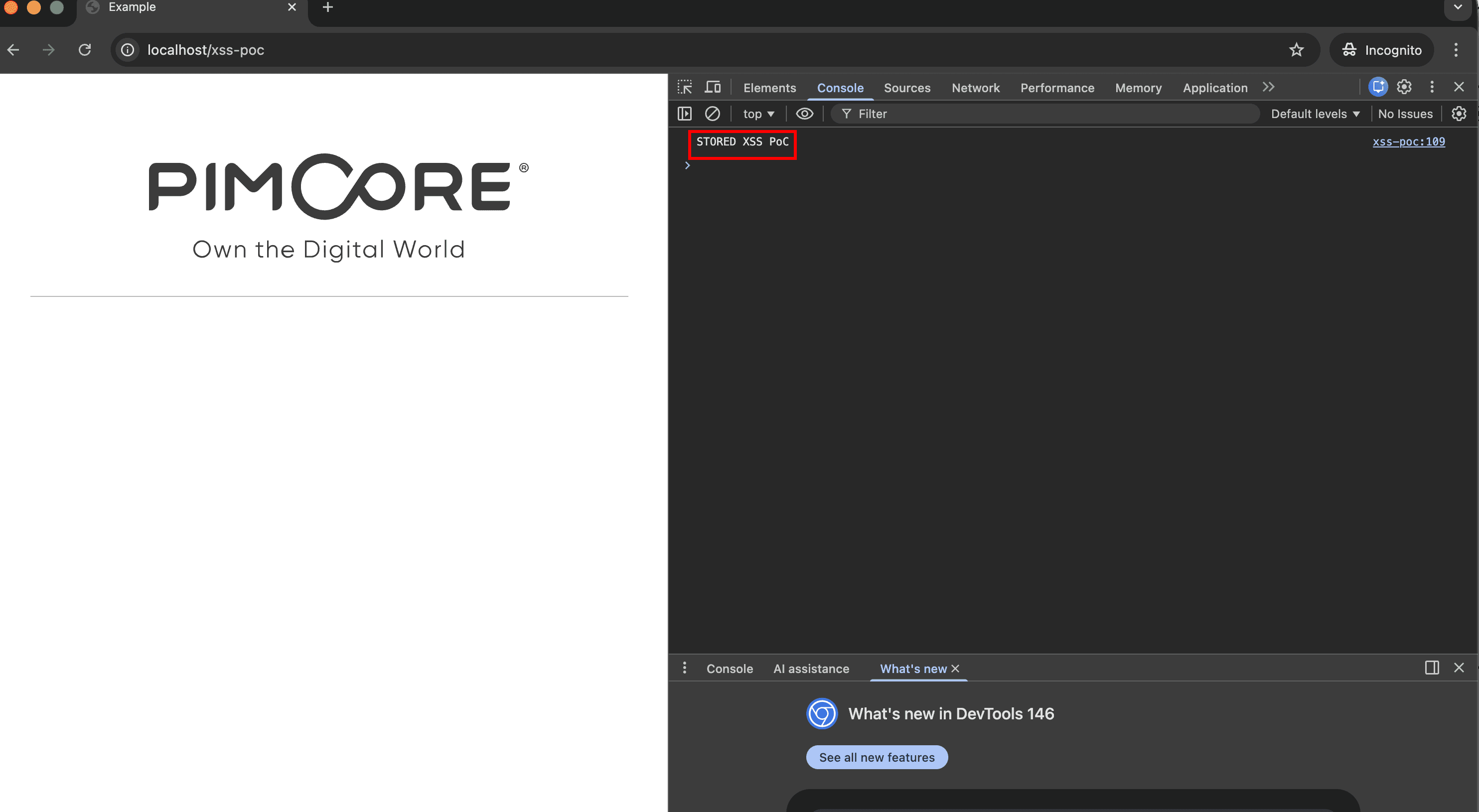
alert("PIMCORE_EMBED_XSS").
Minimal dependency-level confirmation
The underlying dependency behavior can be reproduced with Embera 2.0.14:
Expected result:
First call returns
<script>alert(1)</script>unchanged.Second call returns an embedded YouTube iframe, followed by
<script>alert(1)</script>.
Evidence of Exploitation
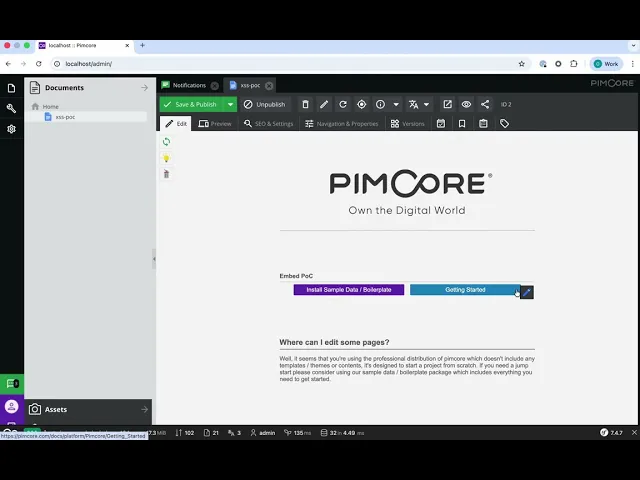
Video of exploitation:
Static evidence:
Our security policy
We have reserved the ID CVE-2026-5362 to refer to this issue from now on.
System Information
Pimcore Platform
Version v12.3.3-62-g271a0a0b7b
Operating System: Any
References
Github Repository: https://github.com/pimcore/pimcore
Security: https://github.com/pimcore/pimcore/security
Mitigation
There is currently no patch available for this vulnerability.
Credits
The vulnerability was discovered by Oscar Naveda from Fluid Attacks' Offensive Team using the AI SAST Scanner.
Timeline
Vulnerability discovered
Vendor contacted
Public disclosure
Does your application use this vulnerable software?
During our free trial, our tools assess your application, identify vulnerabilities, and provide recommendations for their remediation.