Frappe 17.0.0 - Reflected/Stored XSS in File View breadcrumbs rendering
4,6
Medium
Detected by

Fluid Attacks AI SAST Scanner
Disclosed by
Oscar Uribe
Summary
Full name
Frappe 17.0.0 - Reflected/Stored XSS in File View breadcrumbs rendering
Code name
State
Public
Release date
Affected product
Frappe
Vendor
Frappe
Affected version(s)
17.0.0
Vulnerability name
Stored cross-site scripting (XSS)
Vulnerability type
Remotely exploitable
Yes
CVSS v4.0 vector string
CVSS:4.0/AV:N/AC:L/AT:N/PR:H/UI:A/VC:N/VI:N/VA:N/SC:L/SI:L/SA:N
CVSS v4.0 base score
4.6
Exploit available
Yes
CVE ID(s)
Description
A Stored Cross-Site Scripting (XSS) vulnerability exists in Frappe Framework version 17.0.0-dev due to improper neutralization of user-controlled input in the File View breadcrumb renderer. Folder segments derived from the application route are interpolated into HTML templates by get_breadcrumbs_html() without output encoding.
The generated breadcrumb markup is subsequently inserted into the DOM by setup_no_result_area() through jQuery HTML parsing. An attacker can craft a malicious route containing HTML or JavaScript payloads that are rendered and executed when a victim accesses the affected File View page.
Vulnerability
Case A: reflected route-segment XSS in breadcrumbs
Source: attacker-controlled URL segments in File list route.
Propagation:
frappe.get_route()->get_breadcrumbs_html()-> folder title interpolation.Sink:
setup_no_result_area()inserts${this.get_breadcrumbs_html()}using jQuery HTML string constructor and appends to DOM.Impact: payload such as
x"><img src=x onerror=...>executes when breadcrumb HTML is rendered.
Important routing behavior observed:
set_breadcrumbs()mutates route withroute.splice(-1), so payload is most reliable when placed before a trailing segment, e.g./.../<payload>/TAIL.
Case B: stored breadcrumb attribute injection via folder name
Source persistence: File folder names can include quotes (
") and are stored.Server-side constraints: file naming blocks
<and>but does not block quotes in this path.Propagation: malicious folder name appears in non-last breadcrumb item and is interpolated into
<a href="${route}">.Sink behavior: quote breaks
hrefattribute and injects event handler attributes (e.g.,onmouseover=...) that execute on interaction.
Case C: header sink in get_header_html() / ListView.render_header()
get_header_html()embeds unescapedbreadcrumbs_htmlin:<span class="level-item">${breadcrumbs_html}</span>
ListView.render_header()inserts that HTML into the document via:this.$result.prepend(this.get_header_html())
Runtime validation showed injected
<img ... onerror=...>present in.list-row-headand JavaScript execution (executed_flag: true).This confirms exploitability through both FileView sinks:
no-result area (
setup_no_result_area)list header rendering path (
get_header_html->render_header)
Relevant code:
frappe/frappe/public/js/frappe/views/file/file_view.js:39-46frappe/frappe/public/js/frappe/views/file/file_view.js:59-62frappe/frappe/public/js/frappe/views/file/file_view.js:336-356frappe/frappe/public/js/frappe/views/file/file_view.js:360-389frappe/frappe/public/js/frappe/list/list_view.js:622-628frappe/frappe/model/naming.py:522-525frappe/frappe/core/doctype/file/file.py:439-448
PoC
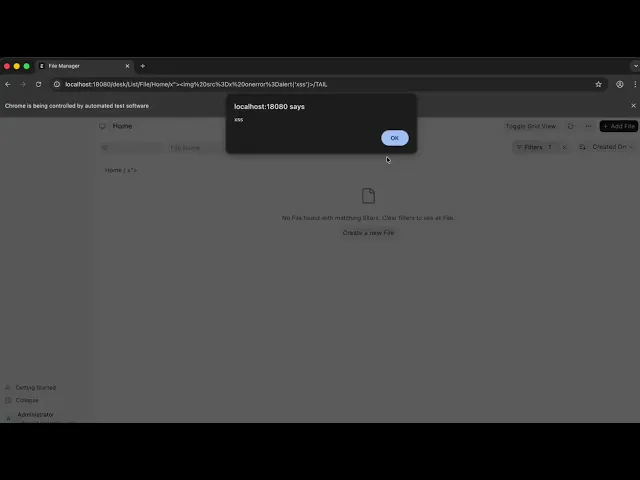
Reflected route PoC
Open while authenticated in Desk:
Alternative non-dialog payload used for deterministic evidence:
Expected result:
Breadcrumb HTML contains injected
<img ... onerror=...>and executes JavaScript.
Stored folder-name PoC
Create folder with quote-based payload:
Create nested subfolders under the payload folder and open a deep route so payload folder appears as a non-last breadcrumb item.
Hover the malicious breadcrumb anchor to trigger the handler.
Evidence of Exploitation
Video of exploitation:
Our security policy
We have reserved the ID CVE-2026-50704 to refer to this issue from now on.
System Information
Frappe Framework
Version 17.0.0-dev
Operating System: Any
References
Github Repository: https://github.com/frappe/frappe
Mitigation
There is currently no patch available for this vulnerability.
Credits
The vulnerability was discovered by Oscar Uribe from Fluid Attacks' Offensive Team using the AI SAST Scanner.
Timeline
Vulnerability discovered
Vendor contacted
Vendor replied
Public disclosure
Does your application use this vulnerable software?
During our free trial, our tools assess your application, identify vulnerabilities, and provide recommendations for their remediation.