LimeSurvey 7.0.5 - Reflected XSS in user activation confirmation endpoint
7,4
High
Detected by

Fluid Attacks AI SAST Scanner
Disclosed by
Miguel Gómez
Summary
Full name
LimeSurvey 7.0.5 - Reflected XSS in user activation confirmation endpoint
Code name
State
Public
Release date
Affected product
LimeSurvey
Vendor
LimeSurvey
Affected version(s)
7.0.5
Fixed version(s)
7.0.12
Vulnerability name
Reflected Cross-site Scripting (XSS)
Vulnerability type
Remotely exploitable
Yes
CVSS v4.0 vector string
CVSS:4.0/AV:N/AC:L/AT:P/PR:N/UI:A/VC:H/VI:H/VA:N/SC:L/SI:L/SA:N
CVSS v4.0 base score
7.4
Exploit available
Yes
CVE ID(s)
Description
LimeSurvey Community Edition 7.0.5 contains an authenticated reflected Cross-Site Scripting vulnerability in the user activation confirmation endpoint. The action query parameter is copied into the response and inserted into a hidden input attribute without HTML attribute encoding.
An attacker does not need a LimeSurvey account. By sending a crafted URL to a user who is authenticated and has the global users:update permission, the attacker can cause arbitrary JavaScript to execute in that user's LimeSurvey origin. The issue can affect user-management administrators and may allow actions or data access available to the victim's session.
Vulnerability
Root cause
The endpoint accepts a client-controlled
actionparameter:The value is inserted into an HTML attribute without context-appropriate encoding:
The response is fetched by the browser and inserted into the modal with
.html(html). A quote can therefore terminate thevalueattribute and add an executable HTML element.
Source-to-sink path
Source: the unauthenticated attacker controls the
actionquery parameter in aGETrequest.Authorization gate: the victim's session must have the global
users:updatepermission. The attacker does not need that permission or an account.Controller:
UserManagementController::actionActivationConfirm()copiesactioninto$aDatawithout allowlisting it toactivateordeactivate.View:
confirmuseractivation.phpinserts$actioninto thevalueattribute of a hidden form input without output encoding.Browser sink: the user-management JavaScript loads the endpoint response into the modal using jQuery
.html(), which parses the injected markup.
Impact
Successful exploitation executes arbitrary JavaScript in the victim's authenticated LimeSurvey administration context. Depending on the victim's permissions, this can expose user-management data, perform same-origin requests, modify administrative state, or perform other actions available to the victim.
The attacker only needs to deliver or induce a privileged victim to open the crafted URL. No stored content, CSRF token, or attacker account is required for the reflected XSS request.
PoC
Preconditions
LimeSurvey Community Edition
7.0.5+260623.A victim is authenticated to the administration panel.
The victim has the global
users:updatepermission.
Reproduction
Deploy LimeSurvey and authenticate as an administrator or as a test user with the global
users:updatepermission.While that session is active, open the following URL. Replace the host and
useridas needed:The endpoint returns the confirmation fragment. The response contains markup equivalent to:
Expected result:
A browser dialog displays
Pwned-action-field.The JavaScript executes in the LimeSurvey administration origin and in the victim's authenticated browser context.
Negative control
With a value that does not break out of the attribute, such as action=activate, the endpoint renders the normal activation confirmation and no injected element is created.
Evidence of Exploitation
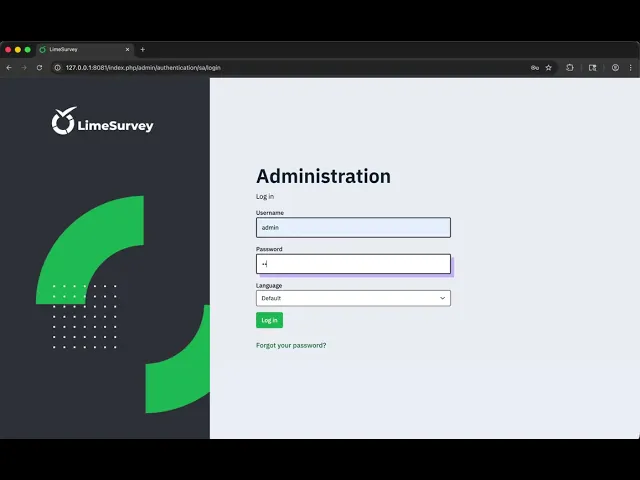
Video of exploitation:
Static evidence:

Our security policy
We have reserved the ID CVE-2026-63360 to refer to this issue from now on.
System Information
LimeSurvey
Version: 7.0.5
Operating System: Any
References
GitHub Repository: https://github.com/LimeSurvey/LimeSurvey/
Patch: https://github.com/LimeSurvey/LimeSurvey/commit/b043e8268542630dd5bb13c3cb1f8e1baf7f25a2
Mitigation
An updated version of LimeSurvey is available on the vendor page.
Credits
The vulnerability was discovered by Miguel Gomez from Fluid Attacks' Offensive Team using the AI SAST Scanner.
Timeline
Vulnerability discovered
Vendor contacted
Vendor replied
Vendor confirmed
Vulnerability patched
Public disclosure
Does your application use this vulnerable software?
During our free trial, our tools assess your application, identify vulnerabilities, and provide recommendations for their remediation.