ExifTool for photo and video 5.0.1 - Local OS command injection through filenames during CSV export
8,4
High
Discovered by

Offensive Team, Fluid Attacks
Summary
Full name
ExifTool for photo and video 5.0.1 - Local OS command injection through filenames during CSV export
Code name
State
Public
Release date
Affected product
ExifTool for photo and video
Vendor
CellHubs
Affected version(s)
5.0.1-gms
Vulnerability name
OS Command Injection
Vulnerability type
Remotely exploitable
Yes
CVSS v4.0 vector string
CVSS:4.0/AV:L/AC:L/AT:N/PR:N/UI:A/VC:H/VI:H/VA:H/SC:N/SI:N/SA:N
CVSS v4.0 base score
8.4
Exploit available
Yes
CVE ID(s)
Description
ExifTool for photo and video 5.0.1-gms by CellHubs constructs shell command strings from file paths and invokes /system/bin/sh -c. In the CSV-export path, the selected media path is merely surrounded with single quotes; embedded single quotes are not escaped. A crafted filename can therefore terminate the intended shell argument and inject arbitrary shell syntax.
An attacker who can place a crafted media file in shared storage, or otherwise persuade the user to select it, can cause commands to execute as the com.exiftool.free application UID when the user exports its metadata to CSV.
Vulnerability
Root Cause
The affected code is obfuscated in classes.dex as defpackage.iz1. Its g(Application application, String str, File file) method builds this shell command:
str is the selected input media path. Wrapping it in ' is not quoting-safe: an apostrophe in the filename ends the quote, and subsequent shell metacharacters are parsed by sh -c. Neither shell escaping nor an argument-vector invocation is used for this path.
Source-to-sink path
Source — attacker-controlled filename: A local attacker creates a media file in shared storage whose filename contains an apostrophe and shell syntax. Android/Linux filenames permit these characters.
Application input: The user selects or imports that file through the normal application interface. The manifest also exposes
ExifEditorActivityforACTION_SENDandACTION_SEND_MULTIPLE, which can make delivery of selected media easier, though the demonstrated CSV flow uses normal UI interaction.Unsafe command construction:
iz1.gconcatenates the selected path into a string for/system/bin/sh -cand does not escape apostrophes.Sink:
ProcessBuilder.command("/system/bin/sh", "-c", command).start()invokes the Android shell, which parses the injected command separators and expansions.Impact: The injected command runs with the UID and granted permissions of
com.exiftool.free, not as root. It may read or modify data accessible to that app and, because the build declares network access, can potentially exfiltrate accessible data.
Impact
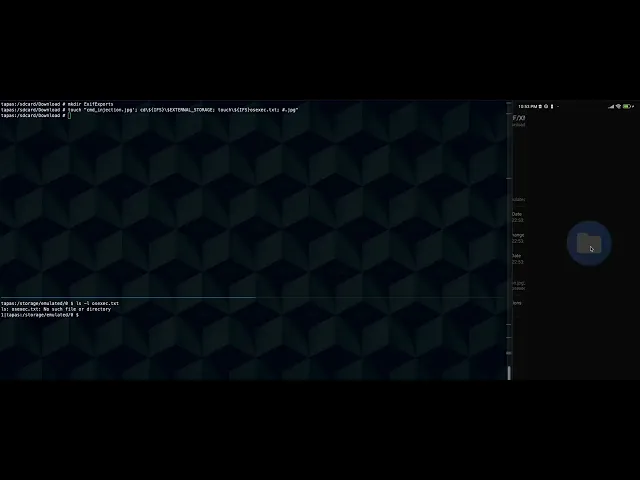
An attacker-controlled filename can execute arbitrary shell commands with the privileges of com.exiftool.free after a user selects that file and exports metadata to CSV. Dynamic validation confirmed this by creating the benign /sdcard/osexec.txt marker through the application's normal export flow.
The command inherits the application's Android UID and its effective permissions. In the analyzed build, this can include broad shared-storage access when the user grants MANAGE_EXTERNAL_STORAGE, access to media granted by the user, and network access (INTERNET). Consequently, a successful exploit can read, modify, create, or delete files accessible to the application and may transmit accessible data over the network. It can also interfere with the CSV-export operation itself.
PoC
Preconditions
The following payload and reproduction method were supplied by the researcher. The crafted file must be placed in a shared-storage directory accessible to the application. In the submitted validation, this was done from an ADB shell:
The victim must be able to select or import the file in ExifTool for photo and video and have a writable destination directory available for the CSV export.
Step-by-step
Open ExifTool for photo and video.
Select or import the crafted file.
Select a destination directory.
Export the metadata as a CSV file.
Verify that
/storage/emulated/0/osexec.txtwas created.
Evidence of exploitation
Video of exploitation:
Static evidence:


Our security policy
We have reserved the ID CVE-2026-101947 to refer to this issue from now on.
System Information
Product: ExifTool for photo and video
Vendor: CellHubs
Package:
com.exiftool.freeAffected version:
5.0.1-gms(versionCode 82)
References
Google Play: https://play.google.com/store/apps/details?id=com.exiftool.free
CellHubs terms: https://cellhubs.app/terms
Mitigation
There is currently no patch available for this vulnerability.
Credits
The vulnerability was discovered by Andrés Ramos from Fluid Attacks' Offensive Team.
Timeline
Vulnerability discovered
Vendor contacted
Public disclosure
Does your application use this vulnerable software?
During our free trial, our tools assess your application, identify vulnerabilities, and provide recommendations for their remediation.