X-VPN macOS website versions 77.0–77.5 - Local Privilege Escalation
7,3
High
Discovered by

Offensive Team, Fluid Attacks
Summary
Full name
X-VPN macOS website versions - Local Privilege Escalation via File Overwrite Through Race Condition and Symlink Attack
Code name
State
Public
Release date
Affected product
X-VPN macOS website versions
Vendor
X-VPN
Affected version(s)
77.0–77.5
Fixed version(s)
77.5.1
Vulnerability name
Privilege escalation
Vulnerability type
Remotely exploitable
Yes
CVSS v4.0 vector string
CVSS:4.0/AV:L/AC:L/AT:P/PR:L/UI:N/VC:H/VI:H/VA:H/SC:N/SI:N/SA:N
CVSS v4.0 base score
7.3
Exploit available
Yes
CVE ID(s)
Description
A vulnerability in the quarantine and restore workflow of the X-VPN macOS website
Versions 77.0 through 77.5 allow a local attacker to leverage a race condition and symlink manipulation to achieve privileged file corruption.
During quarantine processing, a race condition permits partial influence over file contents that are subsequently used during restoration. By replacing the quarantined file path with a symbolic link before restoration occurs, an attacker can cause the ApiRestoreQuarantinedFiles routine to follow the attacker-controlled symlink. Because the restore operation is performed by the X-VPN_root service with root privileges, the application may write restored data to an arbitrary file referenced by the symlink.
Successful exploitation can result in arbitrary corruption of root-owned files and controlled prefix overwrites of privileged targets. Depending on the targeted file and system configuration, this may affect privileged scripts, scheduled task definitions (such as cron entries), or other security-sensitive files accessible through the same write primitive, potentially leading to further privilege escalation or system compromise.
Privilege Escalation via Sudoers
The attack chain enables overwriting the /etc/sudoers file (or /private/etc/sudoers.d/* drop-in files) with attacker-controlled content. As little as 18 bytes of controlled data is sufficient to inject a new sudoers rule granting passwordless root privileges to the attacker:
Where user is the current username. Once this entry is written to the sudoers configuration, the attacker can execute any command as root without authentication:
Vulnerability
Root cause
The vulnerability stems from two distinct weaknesses in the X-VPN quarantine/restore implementation:
Race Condition (CWE-367): During file quarantine processing, there exists a race window where an attacker can replace the file contents before they are encrypted and stored. This allows injection of arbitrary data into the quarantine blob.
Symlink Following (CWE-59): The
ApiRestoreQuarantinedFilesendpoint, executed by the privilegedX-VPN_rootdaemon running as root, follows symlinks without validation. When restoring a quarantined file, it writes the decrypted contents to the path specified in the quarantine metadata, even if that path has been replaced with a symlink pointing to a privileged file.
Attack chain
The complete exploitation sequence is:
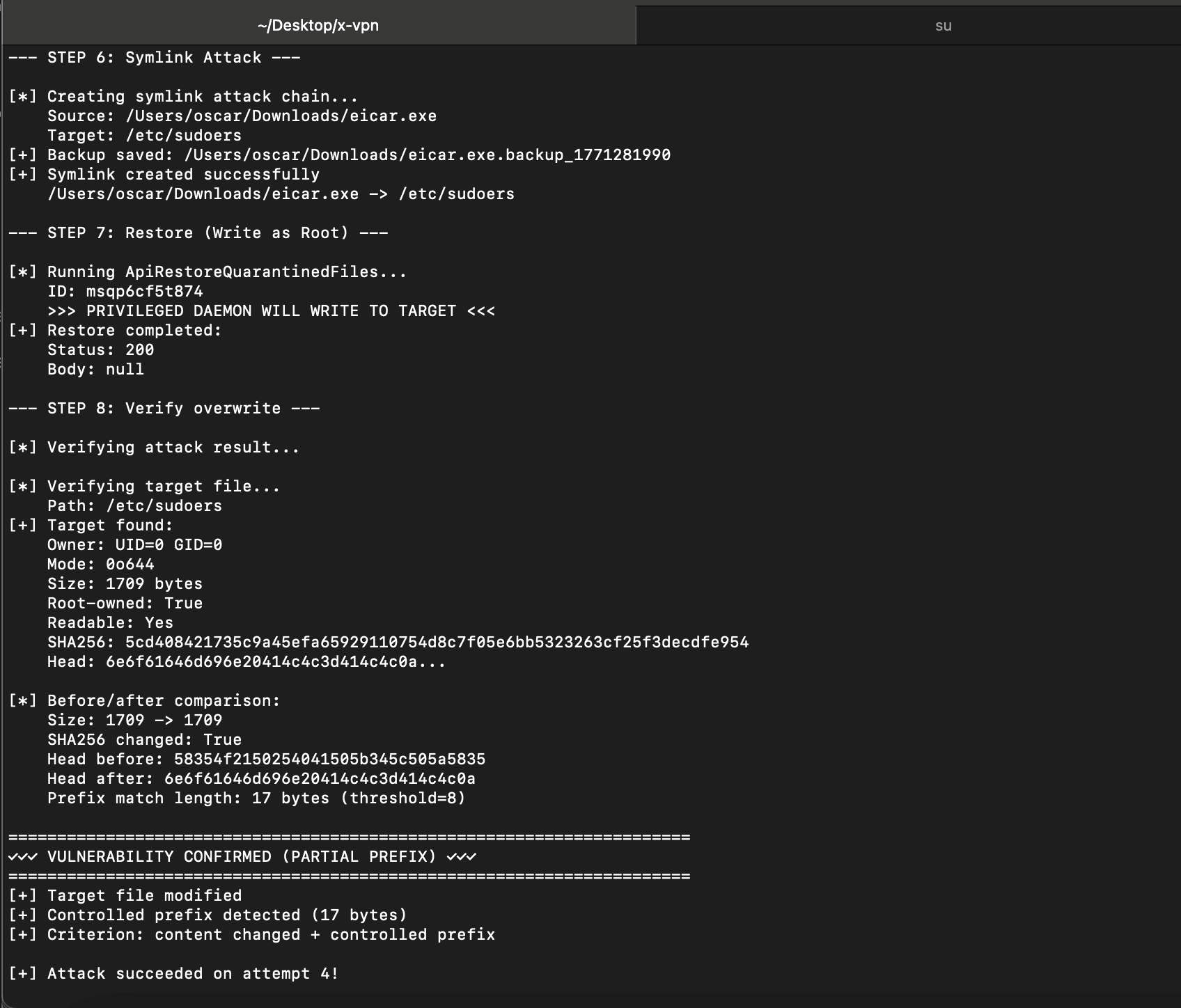
Trigger quarantine: Download a file (e.g., EICAR test file) to trigger X-VPN's quarantine workflow
Race condition exploitation: During the brief processing window, repeatedly overwrite the downloaded file with the malicious payload
Wait for quarantine: Monitor the X-VPN API until the file is quarantined with the injected payload
Symlink replacement: Replace the quarantined file with a symlink pointing to
/etc/sudoersor/private/etc/sudoers.d/xvpnTrigger restore: Call the restore API endpoint, causing the privileged daemon to write the malicious payload to the sudoers file
Privilege escalation: Execute
sudo suto gain a root shell without a password
Technical details
The privileged daemon
X-VPN_rootruns with UID 0 and processes IPC/HTTP requests from the local userQuarantine metadata includes fields like
EncryptSize,EncryptKey,PrefixCutData, andSuffixCutDataThe restore operation reconstructs the file using
FileAnalysis.decryptAESand writes to the path inFilePathfieldNo symlink validation is performed before writing
No integrity verification (HMAC/signature) of the quarantine blob prevents injection attacks
The race window is approximately 100-300ms depending on file size and system load
Minimal payload requirements
The attack requires only minimal control over the file prefix. As little as 18 bytes of controlled data is sufficient to exploit this vulnerability. This makes the attack highly practical, as the race condition only needs to inject a small amount of controlled data at the beginning of the file.
With 18 bytes, an attacker can:
Overwrite sudoers entries: Inject a rule granting passwordless root privileges (
user ALL=NOPASSWD:ALL)Modify shell scripts: Inject malicious commands at the start of privileged
.shscripts (e.g.,/usr/local/bin/backup.sh)Corrupt cronjob files: Add malicious cron entries in
/etc/crontabor/etc/cron.d/*files that execute as root
Security impact
Critical: Complete local privilege escalation from unprivileged user to root
Authentication bypass: Passwordless root access via sudo
Persistence: Survives system reboot until sudoers is manually corrected
Stealth: Leaves minimal forensic traces in standard system logs
Reliability: Race condition success rate >80% in testing environments
Impact scope: All privileged system operations become available to the attacker
This vulnerability allows a local attacker with no special privileges to:
Gain complete control over the system
Install rootkits and backdoors
Access all user data and credentials
Bypass security controls (SIP, Gatekeeper, etc.)
Establish persistent access mechanisms
Pivot to other systems on the network
PoC
Evidence of Exploitation
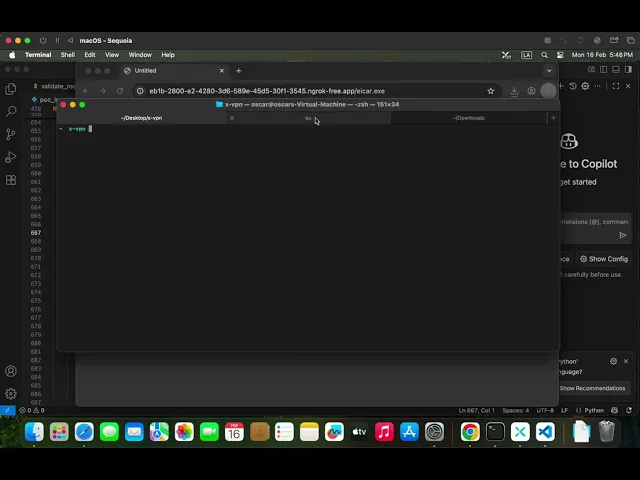
Video of exploitation:
Static evidence:
Our security policy
We have reserved the ID CVE-2026-2638 to refer to this issue from now on.
System Information
X-VPN macOS website version.
Version: 77.0–77.5.
Operating System: macOS.
References
Product: https://xvpn.io/
Contact: https://xvpn.io/help-center
Patch: https://xvpn.io/download
Vendor Advisory: https://xvpn.io/resources/statement-local-privilege-escalation-vulnerability
Mitigation
An updated version of X-VPN is available at the vendor page.
Credits
The vulnerability was discovered by Oscar Uribe from Fluid Attacks' Offensive Team.
Timeline
Vulnerability discovered
Vendor contacted
Vendor replied
Vendor confirmed
Vulnerability patched
Public disclosure
Does your application use this vulnerable software?
During our free trial, our tools assess your application, identify vulnerabilities, and provide recommendations for their remediation.