Filosofia
How to break data silos between dev and security teams


Redator e editor de conteúdo
Atualizado
30 de jan. de 2026
4 min
When developers and security professionals operate in separate ecosystems, critical context stays trapped in one system. Development teams track commits, builds, and deployments in one set of tools; security teams manage vulnerability scans, compliance logs, and threat intelligence in another. Neither sees the full picture.
This isn't merely an operational inconvenience, but rather that fragmentation creates risk blind spots where security weaknesses go undetected, making space for a breach. When security and development data remain siloed, response times slow and security posture weakens. The longer vulnerabilities sit unaddressed because teams can't coordinate effectively, the greater the window for exploitation.
How data silos form
Data silos emerge naturally when departments adopt tools tailored to their specific needs without a unified data strategy. Developers gravitate toward Git, CI/CD platforms, and IDEs; security teams rely on vulnerability scanners, SIEMs, and compliance dashboards. Each toolset generates valuable data, but when these systems don't communicate, teams end up exchanging information through PDFs, emails, and manually created tickets, introducing delays and stripping away context.
The consequences compound quickly. Security teams flag a vulnerability but lack visibility into release timelines or code ownership; developers receive reports without understanding severity or business impact. By the time information passes through these manual handoffs, the window for efficient remediation has often closed.
The real cost of fragmented visibility
The attack surface grows naturally as development continues; that's unavoidable. What silos do is extend the exposure window, the time between when a vulnerability is detected and when it's actually fixed. Every day a vulnerability remains open is another day it can be exploited.
When security flags an issue following vulnerability assessment but developers don't see it until days later, or when developers fix something but security can't verify the fix without a manual back-and-forth, remediation cycles stretch unnecessarily. Accountability becomes unclear: security assumes development is handling it; development assumes it's not urgent because no one followed up. Meanwhile, the vulnerability remains open.
Compliance suffers too. Auditors expect clear trails showing when issues were identified, who was responsible, and how they were resolved. Fragmented systems make that documentation painful to assemble, if it's even possible.
What breaking silos actually requires
Eliminating data silos demands both cultural and technical shifts. It starts with recognizing that development and security share a single goal: delivering secure, reliable software. This is the core premise of DevSecOps, a culture where security is integrated from the beginning of the SDLC and treated as everyone's responsibility. But that culture can't take root if teams are still working with fragmented data; they need a platform where both sides access the same vulnerability information, in real time, with the context required to act. Implementing DevSecOps is a broader task, which you can read about in our blog.
How Fluid Attacks bridges the gap
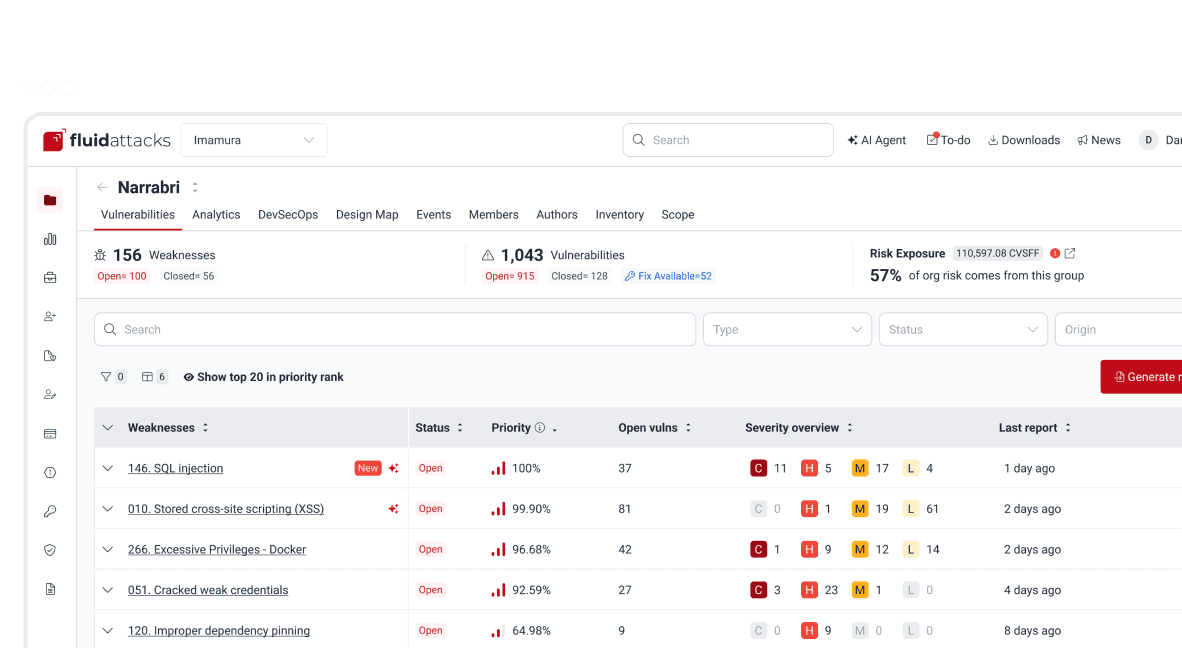
Fluid Attacks' platform is designed to unify development and security workflows from day one. Rather than forcing teams to reconcile data from disparate tools, it consolidates findings from continuous scanning (SAST, AI SAST, DAST, SCA) and manual testing into a single pane of glass. Both developers and security professionals see the same vulnerabilities, severity scores, and remediation guidance.
A single source of truth. Every vulnerability, whether detected by automated scans or pentesters, appears in one centralized view. This is the core value of an ASPM (application security posture management) approach: even when teams use different tools across the SDLC, findings consolidate into a single platform. Developers see exactly where issues exist in their code; security teams see risk exposure across the entire project.
Risk-based prioritization. In the platform, findings are related to the threat model and prioritized based on risk exposure, reachability, exploitability (EPSS), KEV status, transitivity, and fixing cost. And many of these characteristics can be given a weight by the security team, so that the priority score reflects what their organization cares about the most.
Direct assignment and tracking. Security teams can assign specific vulnerabilities directly to the responsible developer from the platform. Those assignments appear in a dedicated "To do" section, so developers know exactly what needs their attention. The platform tracks treatment status, whether a vulnerability is in progress, temporarily accepted, or permanently accepted, with full justification and audit trails.
Compliance visibility for all teams. The platform tracks compliance with international standards like ISO 27001, SOC 2, PCI DSS, OWASP, and dozens more, showing exactly which requirements remain unfulfilled and which vulnerabilities are blocking compliance. Both developers and security teams see the same compliance posture, understand the estimated time to full compliance, and can drill down into specific gaps or generate detailed reports for auditors.
Integrated ticketing. The platform connects directly to Jira and Azure DevOps, allowing teams to create and link issues without leaving their existing workflows. Vulnerability status syncs automatically; when a developer closes a ticket, that progress reflects in the security dashboard (Analytics section).
Verification without friction. Once developers believe they've fixed a vulnerability, they can request a reattack directly from the platform, IDE or ticketing system. Fluid Attacks' team verifies whether the fix was effective, providing evidence either way. This closed-loop process eliminates the back-and-forth emails that typically delay remediation cycles.
Expert guidance on demand. For complex vulnerabilities, developers don't have to guess at solutions. The Talk to a Pentester feature allows them to schedule sessions with a security expert. AI-powered features like Autofix and Custom Fix also provide remediation suggestions directly in the platform or IDE.
IDE extensions that keep developers in flow. Extensions for VS Code, IntelliJ, and Cursor bring vulnerability data directly into the development environment. Developers can see issues, access fix suggestions, and request reattacks without switching contexts.
CI Gate integration. CI Gate can break builds when vulnerabilities exceed defined thresholds, ensuring security policies are enforced automatically. This embeds security checks into the pipeline rather than treating them as a post-development afterthought. Our latest annual report found that teams experience a 50% decrease in median remediation time when they fail CI/CD pipelines due to vulnerability management policies.
The outcome
When development and security operate from a unified platform, organizations achieve faster remediation because vulnerabilities route directly to responsible developers with full context; clear accountability since every issue has a responsible, a treatment status, and a complete audit trail; compliance readiness because centralized data supports reporting against dozens standards; and real strategic visibility, giving leadership accurate metrics on MTTR, remediation rates, and risk trends across the entire project.
Breaking data silos isn't a one-time project but rather an ongoing commitment to treating security as a shared responsibility. But with a platform built for collaboration between dev and security teams, organizations gain the unified visibility they need to remediate faster, reduce risk, and ship secure software without delays.

Get started with Fluid Attacks' ASPM solution right now
Assine nossa newsletter
Mantenha-se atualizado sobre nossos próximos eventos e os últimos posts do blog, advisories e outros recursos interessantes.
Outros posts